
There is an undeniable sense of milestone achievement when you finalise the purchase of a new or second-hand vehicle. You have signed the paperwork, chosen the ideal colour scheme, and visualised the freedom of the open road.
However, the physical purchase price of a vehicle is merely the opening chapter of a much larger financial commitment. Many British motorists budget exclusively for the upfront cost or the monthly finance payment, entirely overlooking the secondary network of mandatory running expenses. Within twelve months of ownership, a stream of automated direct debits, test reminders, and mechanical wildcards begin to arrive, frequently totalling thousands of pounds per year.
To keep your personal finances completely secure, it is essential to look past the showroom price tag and break down the operational expenses that dictate the true cost of keeping a vehicle on public roads.
The Baseline Essentials: Insurance and Annual Vehicle Tax
Maintaining a vehicle legally in the UK starts with handling the two primary administrative outlays that every motorist faces, regardless of how many miles they actually cover.
1. The Insurance Landscape
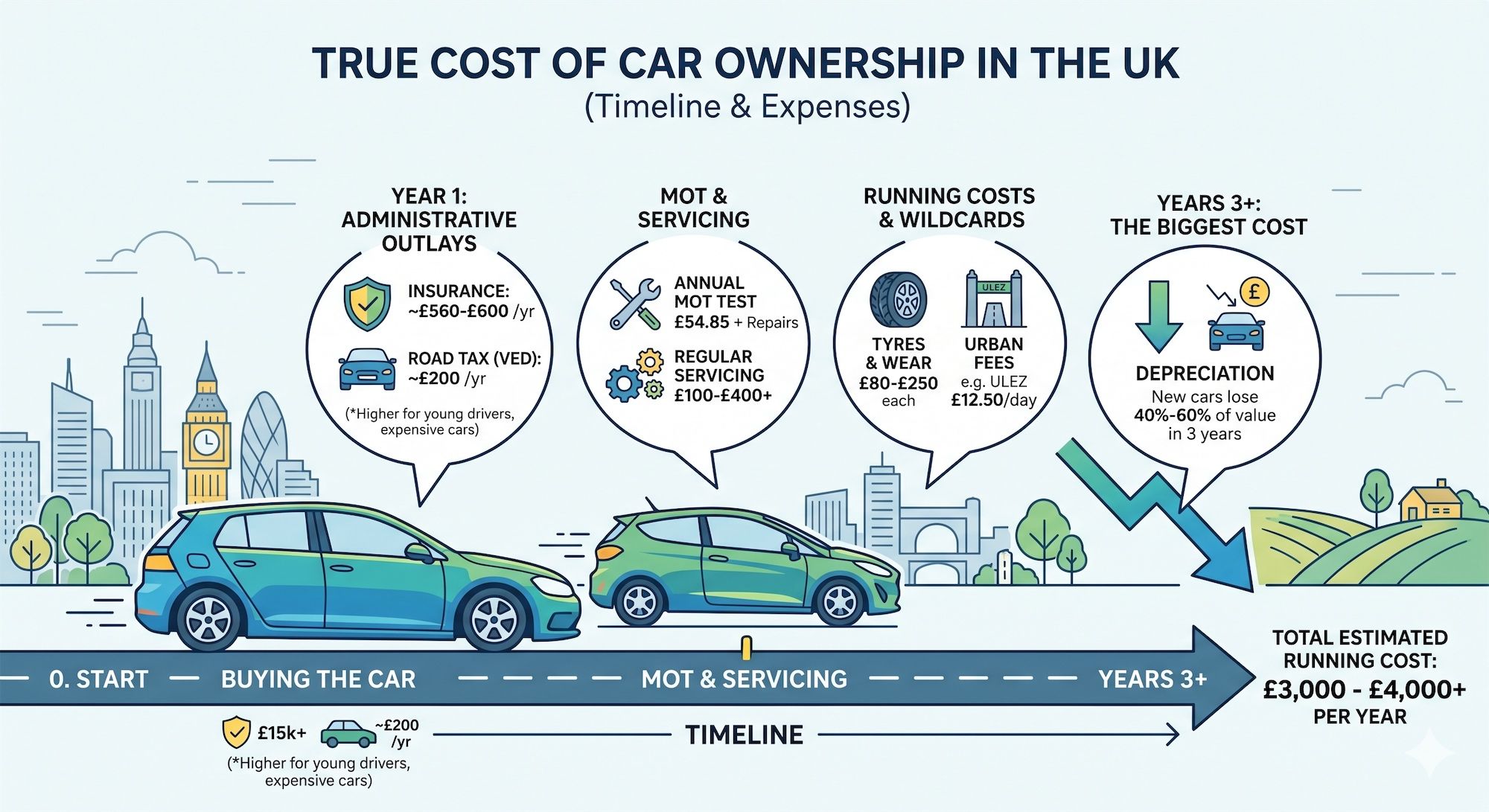
Motor insurance is typically the single largest ongoing expense for UK drivers. Following a period of notable volatility, average comprehensive premiums have found a steady baseline of around £560 to £600 per year.
However, a standard national average rarely reflects an individual's actual invoice. Your final quote is heavily dictated by localised zip codes, claims history, occupational risks, and age brackets. While a driver in their late forties residing in rural Wiltshire might comfortably clear their insurance for under £450, a young motorist under twenty-four or a resident navigating urban London can easily face annual quotes soaring past £1,100 to £1,500.
Important Policy Reminder: If you choose to split your annual premium into twelve monthly instalments, you are effectively taking out a high-interest consumer credit agreement. This subtle convenience typically adds a hidden 10% premium onto your overall cost, making it significantly cheaper to pay upfront if your liquid capital allows.
2. Vehicle Excise Duty (VED)
Commonly referred to as road tax, VED calculation rules depend heavily on when your vehicle was first registered. If your car was registered on or after April 1st, 2017, the system drops the traditional sliding emissions scale after the initial year and moves onto a standard flat rate of £200 annually.
Furthermore, if the vehicle carried a manufacturer list price of over £40,000 when brand new, you are hit with an additional Expensive Car Supplement of £440 per year from years two through six. For older cars registered before April 2017, the entire fee is strictly calculated on carbon dioxide grams per kilometer, scaling anywhere from zero pounds for eco-friendly hatchbacks to over £700 per year for high-performance petrol variants.
The Annual Verification: MOT Testing and Preventative Servicing
The mechanical roadworthiness of your vehicle is evaluated through a blend of statutory safety checks and routine engine preservation.
3. The Mandatory MOT
Once a vehicle passes its third anniversary, it must successfully clear a Ministry of Transport (MOT) safety test every twelve months. While the maximum statutory fee a garage can legally charge for the test itself is capped at £54.85, the true cost of an MOT is rarely the test fee.
The real expense lies in the surprise component failures flagged by the technician. Common mechanical issues like heavily worn brake discs, split suspension bush rubbers, or corroded exhaust brackets must be addressed before the vehicle can be legally driven away.
To insulate yourself from unexpected test-day failures, it is incredibly useful to monitor what is coming down the line. Using an automated diagnostic platform like CheckVehicle.ai allows you to drop in your registration plate and instantly evaluate your historical advisory notes, identifying recurring suspension or braking faults well in advance.
4. Scheduled Mechanical Servicing
An MOT test checks if a car is safe to drive, not if the engine is running efficiently. To prevent premature internal component wear, regular mechanical intervention is required.
- Minor Interim Service (Every 6,000 Miles): Focuses primarily on clean engine oil and filter changes, costing between £100 and £200.
- Full Comprehensive Service (Every 12,000 Miles): Includes full air filter swaps, spark plug replacement, brake fluid flushing, and systemic safety checks, scaling between £200 and £400.
- Major Structural Service (Every 24,000 Miles): Addresses heavy wear items like fuel filters and gearbox fluid changes, generally ranging from £400 to £800.
Wear, Tear, and Environmental Levies
Beyond the fixed calendar appointments, running a car means navigating everyday environmental charges and unpredictable components that break down naturally over time.
5. The Wear and Tear Wildcards
Every mile driven degrades sacrificial components. Tyres require replacing as their tread drops toward the legal 1.6mm limit, costing anywhere from £80 to £250 per corner depending on rim diameter.
Vehicle batteries typically lose their charging capacity every four to five years, requiring an investment of £100 to £200. Heavy mechanical milestones like replacing a slipping clutch or fitting a fresh timing belt kit frequently run into high-triple or low-quadruple figures, highlighting the necessity of keeping an emergency maintenance buffer.
6. Urban Charges and Parking Permitting
Where you live and drive changes your daily overheads significantly. Local municipal councils frequently charge between £50 and £250 annually for localised residential parking permits.
If your travel takes you near strict low-emission zones, such as London’s Greater ULEZ or Class D Clean Air Zones in Birmingham and Bristol, driving a non-compliant vehicle triggers immediate automated penalty systems. Simply crossing into these zones in an older diesel or petrol vehicle will cost you a steep £12.50 daily fee, making it essential to confirm your vehicle's clean-air clearance on an online platform like CheckVehicle.ai before coordinating a city commute.
The Invisible Financial Leak: Depreciation
The most significant expense associated with vehicle ownership is one that never leaves a physical printout on a receipt, making it completely invisible to most drivers until they eventually try to trade their car in.
A brand-new car typically sheds between 40% and 60% of its initial retail value within the first thirty-six months of its life. If you buy a showroom model for £30,000, you are effectively losing up to £5,000 per year in pure asset value while it sits on your driveway.
While this makes the used car market an incredibly smart choice for avoiding the initial depreciation drop, used cars carry a higher risk of unexpected component degradation. Striking the ideal financial balance means hunting for a well-maintained second-hand vehicle backed up by a clean, fully traceable history log.
Final Thoughts
The freedom of vehicle ownership is incredibly liberating, but maintaining that freedom requires realistic budgeting. When you add together your comprehensive insurance, annual VED tax, mandatory MOT tests, regular oil changes, and natural fuel or charging costs, the true financial footprint of running a vehicle in the UK comfortably sits at an average of £3,000 to £4,000 per year.
Before committing your savings to a vehicle purchase, protect yourself from unexpected financial pressure. Take two minutes to run the vehicle's registration through a dedicated background tool to ensure you understand exactly what your upcoming tax, insurance, and maintenance liabilities look like before you drive home.