
Running a company car in the UK in 2026 is far more about tax strategy than vehicle preference. Fleet electrification is well underway, but recent changes to Benefit-in-Kind (BiK) rates, luxury car thresholds, and HMRC reporting mean the math behind choosing a car has shifted.
Whether you run a fleet or are looking at a salary sacrifice scheme through your employer, here is what you need to know to make the numbers work and avoid an unexpected tax bill.
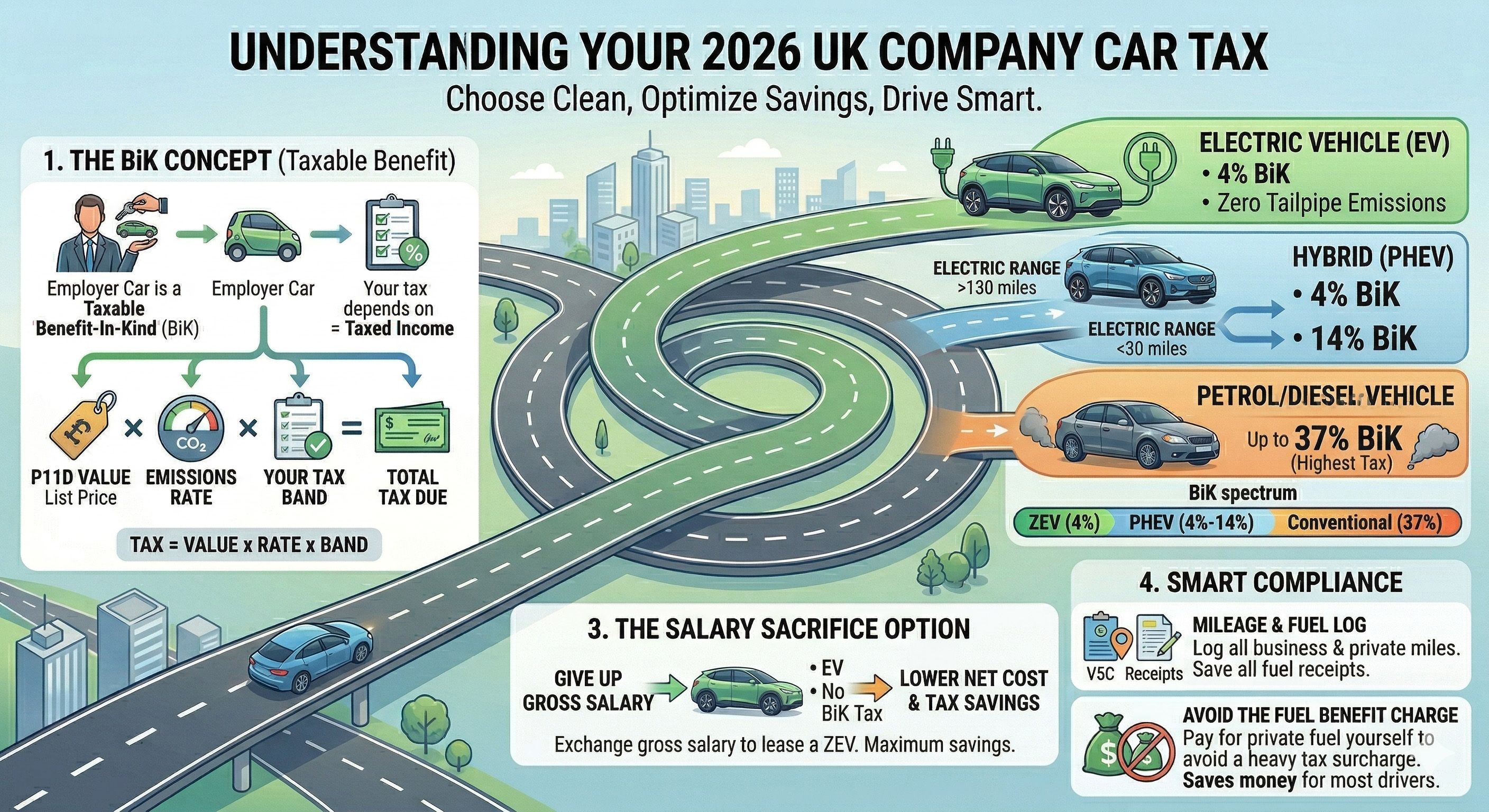
How Company Car Tax (BiK) Works
When your employer provides a car that is available for private journeys (including everyday commuting), HMRC treats it as a non-cash perk called a Benefit-in-Kind (BiK).
Your annual tax bill is calculated using three figures:
- P11D Value: The car’s official list price, including VAT, delivery charges, and all factory-fitted options (excluding first-year road tax and registration fees).
- BiK Tax Band: A percentage set by HMRC based on the car’s CO2 emissions and, for plug-in hybrids, its zero-emission electric range.
- Your Income Tax Band: Whether you pay 20% (basic rate), 40% (higher rate), or 45% (additional rate).
The basic formula:
(P11D Value × BiK Percentage) × Your Income Tax Rate = Annual Tax Bill2026/27 BiK Rates: The Electric and Hybrid Landscape
Pure Electric Vehicles (EVs)
For the 2026/27 tax year, the BiK rate for zero-emission vehicles sits at 4% (up from 3% in 2025/26 and 2% before that).
Even with this 1% annual increase, pure EVs remain vastly cheaper from a tax perspective than traditional combustion engine cars. A standard petrol or diesel hatchback often sits between 25% and 37% BiK, costing thousands of pounds more in personal tax each year.
- Worked Example: An electric car with a P11D value of £45,000 at a 4% BiK rate has a taxable value of £1,800 per year.
- A 20% basic rate taxpayer pays £360 per year (£30 per month).
- A 40% higher rate taxpayer pays £720 per year (£60 per month).
Plug-in Hybrids (PHEVs)
If you choose a plug-in hybrid emitting 1 to 50g/km of CO2, the tax rate depends heavily on how far the car can travel purely on battery power:
- Over 130 miles electric range: 4% BiK (matches pure EVs)
- 70 to 129 miles: 5% BiK
- 40 to 69 miles: 8% BiK
- 30 to 39 miles: 12% BiK
- Under 30 miles: 14% BiK
Choosing a PHEV with a small battery and a short real-world range can more than triple your tax liability compared to a longer-range alternative.
The £50,000 EV Luxury Surcharge Adjustment
Historically, vehicles with a list price above £40,000 were hit with the Expensive Car Supplement, adding an extra annual surcharge to Vehicle Excise Duty (VED) for five years. Because electric battery technology kept vehicle list prices relatively high, this created an unwelcome penalty for drivers trying to adopt clean vehicles.
Recognising this imbalance, the threshold for zero-emission vehicles was raised to £50,000.
For fleet operators and company car drivers, this change keeps mid-tier family electric SUVs (priced between £40,000 and £50,000) free from the supplement. This directly lowers monthly lease costs passed down via employer schemes.
Why "Free" Company Fuel Is Rarely Worth It
If your company pays for the petrol or diesel you use for private journeys, HMRC applies a separate Fuel Benefit Charge.
For the 2026/27 tax year, the baseline multiplier is £29,200.
To work out what you owe, multiply £29,200 by your car’s BiK percentage, then by your income tax rate.
- On a petrol car in the 35% BiK band, the taxable benefit value is £10,220.
- A 40% taxpayer pays £4,088 a year (£340+ per month) purely for the privilege of having private fuel covered.
Unless you are driving tens of thousands of personal miles every single year, you are almost always better off paying for your own fuel and claiming back business miles using HMRC's Advisory Fuel Rates (AFR).
What about charging electric cars?
Providing electricity for a company EV does not trigger the Fuel Benefit Charge. When reimbursing employees for business mileage driven in an EV, employers can use HMRC's Advisory Electricity Rate (AER), currently benchmarked quarterly (typically 7p to 9p per mile), without creating a taxable event.
Why Salary Sacrifice Remains the Most Efficient Route
Salary sacrifice has become the primary route for UK employees to get behind the wheel of a brand-new car.
Under these schemes, you agree to give up a portion of your gross monthly salary before tax and National Insurance are deducted. In return, your employer provides a fully maintained, insured electric car.
While HMRC's Optional Remuneration Arrangements (OpRA) rules crack down on salary sacrifice for petrol and diesel cars, ultra-low emission vehicles (under 75g/km CO2) are exempt. This means you are taxed only on the tiny 4% BiK value rather than the larger amount of gross salary sacrificed.
For higher-rate (40%) and additional-rate (45%) earners, this creates significant monthly savings compared to taking out a private personal contract hire (PCH) agreement using take-home pay.
Real-Time Payrolling and HMRC Digital Audits
The compliance side of vehicle perks has tightened significantly:
- The End of Year-End P11D Lag: Most businesses have shifted to Payrolling Benefits in Kind. Rather than waiting for a P11D form in July followed by a messy tax code adjustment, the benefit tax is deducted directly from your payslip each month.
- Automated Mileage Cross-Referencing: HMRC uses increasingly connected data sets. Business mileage claims can be checked against MOT odometer histories, telematics data, and fuel card logs.
- The Commuting Rule: Journeys between your permanent home and your regular workplace are strictly classified as private journeys by HMRC. Logging commuting miles as business mileage remains one of the most common triggers for employer audits and back-tax demands.
Summary Checklist for Compliance
To stay compliant and tax-efficient in 2026, follow these four rules:
- Verify the P11D: Ensure your employer has the correct list price, including those expensive "Launch Edition" alloys you chose.
- Log Every Mile: Use a digital logbook or an app that separates business and private trips. HMRC no longer accepts "roughly 100 miles a week" as a valid entry.
- Reimburse Private Fuel: If you have a fuel card, ensure you are "making good" the cost of personal miles at the correct HMRC Advisory Fuel Rates to avoid the heavy Fuel Benefit Charge.
- Check the V5C: Make sure the CO2 figure on your tax record matches the official figure in your logbook. Even a 1g/km error can push you into a higher tax band.
Looking Ahead: The Bottom Line for Drivers and Fleets
The UK company car model has evolved into a system designed around transparency and low emissions. While zero-emission BiK rates will continue to increase gradually over the coming years, the combination of 4% BiK, the £50,000 luxury tax buffer, and strong National Insurance savings on salary sacrifice keeps electric company cars among the most tax-efficient workplace perks available.
For drivers and fleet operators alike, the winning strategy in 2026 comes down to two fundamentals: picking vehicles with verified range efficiency, and maintaining accurate, real-time records for every journey taken. With the numbers aligned, the company car remains a powerful asset for employees and businesses alike.