
The used car market in the UK remains a complex and often intimidating landscape. For many motorists in 2026, navigating high prices and the surge of pre-owned electric vehicles means making a fundamental decision: do you hand your money to a registered business or to the person standing on their driveway?
The choice isn't purely about the bottom line. It is a fundamental trade-off between financial savings and comprehensive legal security. As an automotive content manager, I have seen drivers experience tremendous satisfaction from both routes, just as I have witnessed costly mistakes. Before you even search for a specific model, you must understand the rules of engagement for both paths.
The Legal Landscape: Rights vs. Risk
The most significant difference between the two methods isn’t the car’s condition, but the legal relationship you establish. When you buy from a dealer, you are engaging in a business transaction protected by some of the most robust consumer legislation in the world. When you buy privately, you are engaging in a "caveat emptor" (buyer beware) transaction with very little legal safety net.
Buying From a Used Car Dealer
A registered dealer is any business that buys or sells cars as their primary function. This includes large car supermarkets, franchise dealers for specific brands, and smaller independent garages.
The Pros:
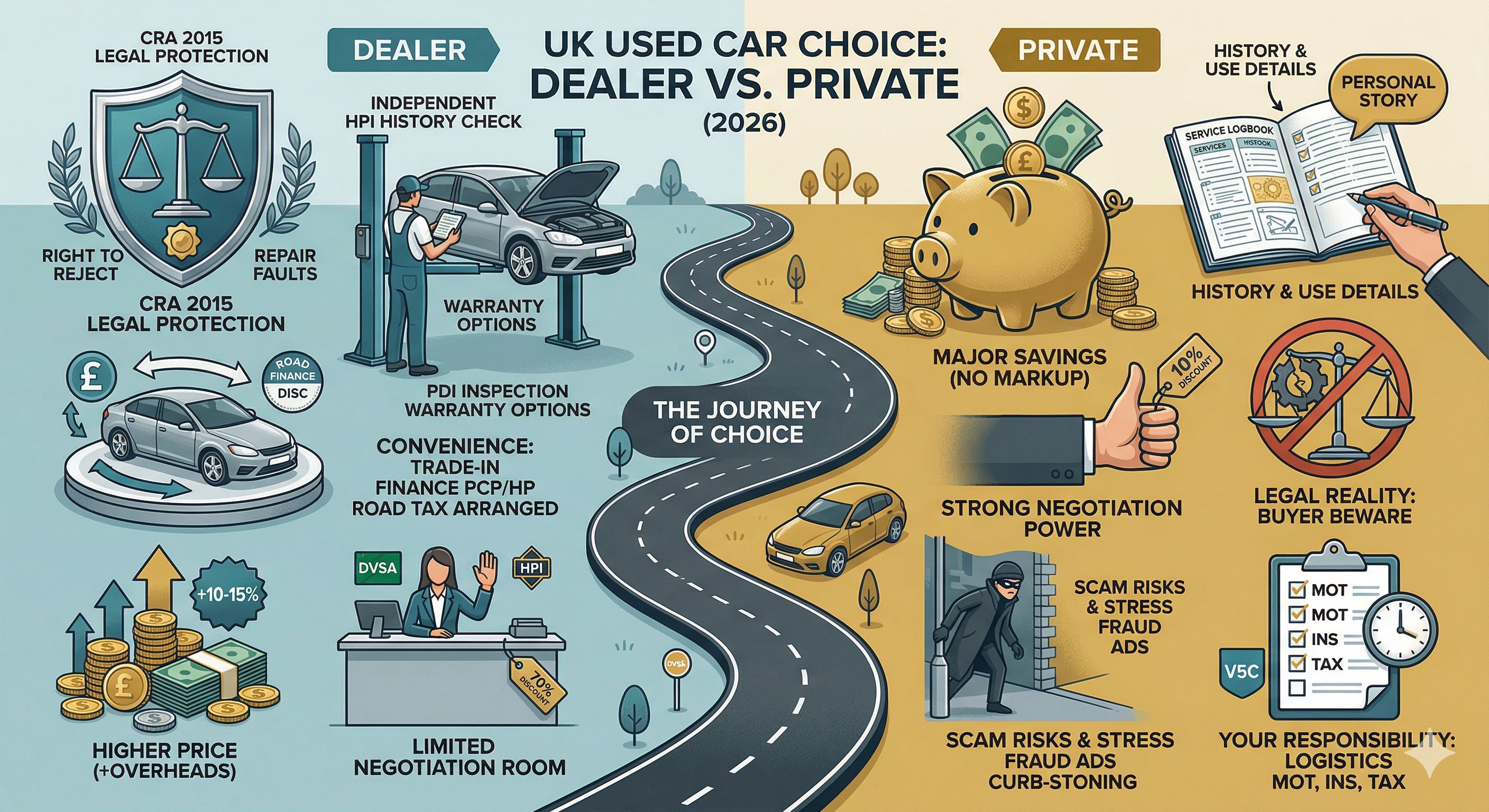
- Consumer Rights Act 2015: This is the dealer’s primary advantage. Under this act, the vehicle must be of "satisfactory quality," "fit for purpose," and "as described." If a significant fault develops within the first 30 days, you have a legal "short-term right to reject" the car for a full refund. Beyond 30 days (up to 6 months), the law generally assumes the fault was present at the time of sale, making it the dealer's responsibility to repair or replace it (unless they can prove otherwise).
- Peace of Mind and Preparation: Dealers live and die by their reputation. To protect it, they almost always perform an independent history check (like HPI) to ensure the car isn't stolen, written off, or burdened with outstanding finance. They will usually perform a full "PDI" (Pre-Delivery Inspection), address advisories from the last MOT, and often provide a standard mechanical warranty (3 to 12 months) as part of the package.
- Convenience and Trade-Ins: Dealers make the logistical challenge easier. They can often provide competitive financing options (PCP or HP), arrange the new road tax on your behalf, and provide a hassle-free "part-exchange" service for your existing vehicle, meaning you drive in with one car and drive out with another.
The Cons:
- The Price: Quality comes at a cost. Dealers have significant overheads: staff wages, rent, business taxes, the cost of their preparation facilities, and the price of the warranty itself. As such, you will almost certainly pay 10% to 15% more for the same model at a dealer than you would privately.
- Less Room to Negotiate: Because the dealer has often invested money in preparation, history checks, and the warranty, their profit margin is relatively slim. While they may "throw in" a free MOT or service, you are less likely to negotiate a massive discount on the sticker price.
Buying a Car Privately
A private sale is a transaction between you and the person whose name is on the V5C logbook, who is selling a single vehicle they personally own.
The Pros:
- Financial Savings: This is the primary driver for private sales. By cutting out the business middleman and their overheads, you get to keep that 10% to 15% markup in your own pocket. If you are budget-conscious, this is where you will find the absolute best "pounds per car" ratio.
- Knowing the History: Talking to the owner gives you an invaluable insight that no service book can provide. You can judge their character, see the environment the car was kept in, and often get a real, honest answer about that one rattle or how it performs on a cold morning. A genuine, long-term owner is often the best source of maintenance information.
- Strong Negotiation: A private seller isn't protecting a profit margin for a business; they are simply disposing of an asset. They are much more likely to accept a low offer, especially if they are looking for a quick sale to release equity or make space for a new vehicle.
The Cons:
- The Legal Reality: Sold as Seen: This is the ultimate "deal-breaker" for many. After you drive away, there is almost no legal avenue for recourse. If the engine explodes the next morning or the gearbox fails on the motorway home, the car is now your problem. You have no rights under the Consumer Rights Act.
- Scam Risks: The private market is a playground for scammers. From "curb-stoning" (unlicensed dealers posing as private sellers to avoid giving consumer rights) to fraudulent HPI reports, the risks are high. Payment is also stressful: handing over thousands of pounds in cash or by bank transfer to a stranger comes with inherent anxiety.
- Logistics: Everything is your responsibility. You must arrange viewing times that suit the seller, perform your own detailed history check, organise a pre-purchase mechanical inspection if you aren't an expert, and arrange your own insurance and tax before you drive it away.
Key Considerations for 2026: Used EVs and Digital History
As we move into the mature phase of the UK used EV market in 2026, the complexity of this choice has shifted.
- Used Electric Vehicles: If you are buying a used EV, a dealer has a significant advantage: Battery Health Verification. Modern 2026 dealer diagnostics can often provide a certified "State of Health" (SoH) test for the battery pack. Private sellers might not have this, meaning you are taking a multi-thousand-pound gamble on the vehicle's remaining range.
- The Digital Fingerprint: The UK has successfully moved to digital-only service records in 2026. Whether you are buying from a dealer or privately, always ask the seller to provide their unique "V5C check number", and the last two digits of the VIN before you even travel. You can then use the official GOV.UK tools and comprehensive third-party data checks (HPI, CarVertical, etc.) to instantly verify mileage, write-off status, and whether the car still has outstanding finance. Never buy a car without performing these checks yourself.
Decision Matrix: Which Path is Right For You?
The best choice depends entirely on your mechanical knowledge, your budget, and your appetite for risk.
- A Dealer is the right choice if: This is your first car. You are buying a vehicle under 3 years old (where significant value is protected by rights). You need finance or a part-exchange. You are not mechanically minded and want a warranty as a safety net.
- A Private Sale is the right choice if: You are working with a tight budget (under £5,000 where dealer margins can double the car’s worth). You are an experienced motorist with mechanical knowledge, or you are willing to hire an inspector. You are buying an older, "classic" vehicle where the owner’s story is everything.
Conclusion
There is no "right" way to buy a used car in the UK; there is only the way that is right for you. If you choose the private route, you can secure exceptional value, but only if you mitigate the risks through diligent checks and pre-purchase inspections. If you choose a dealer, you are paying for security, but it is a security that protects you from the stressful and expensive reality of "Sold as Seen." By 2027, the digital checks will be as important as the mechanical ones, but for now, your first step is deciding which relationship you are willing to build.