If you think your local low-emission zone is tough, a quick look around the global landscape in 2026 might change your mind. The days of simply banning 20-year-old "smoke-belchers" are long gone. Today, the world's major hubs are shifting their focus from "Low Emission" to "Zero Emission" zones. In many of these cities, even a brand-new hybrid might not be enough to get you past the cameras.
As a journalist in the automotive space, I have watched these regulations evolve from minor suggestions into some of the most complex legal frameworks drivers have ever faced. For anyone planning a road trip or looking at the resale value of their current car, understanding these "strictest" zones is no longer optional.
1. Stockholm: The Zero Emission Pioneer
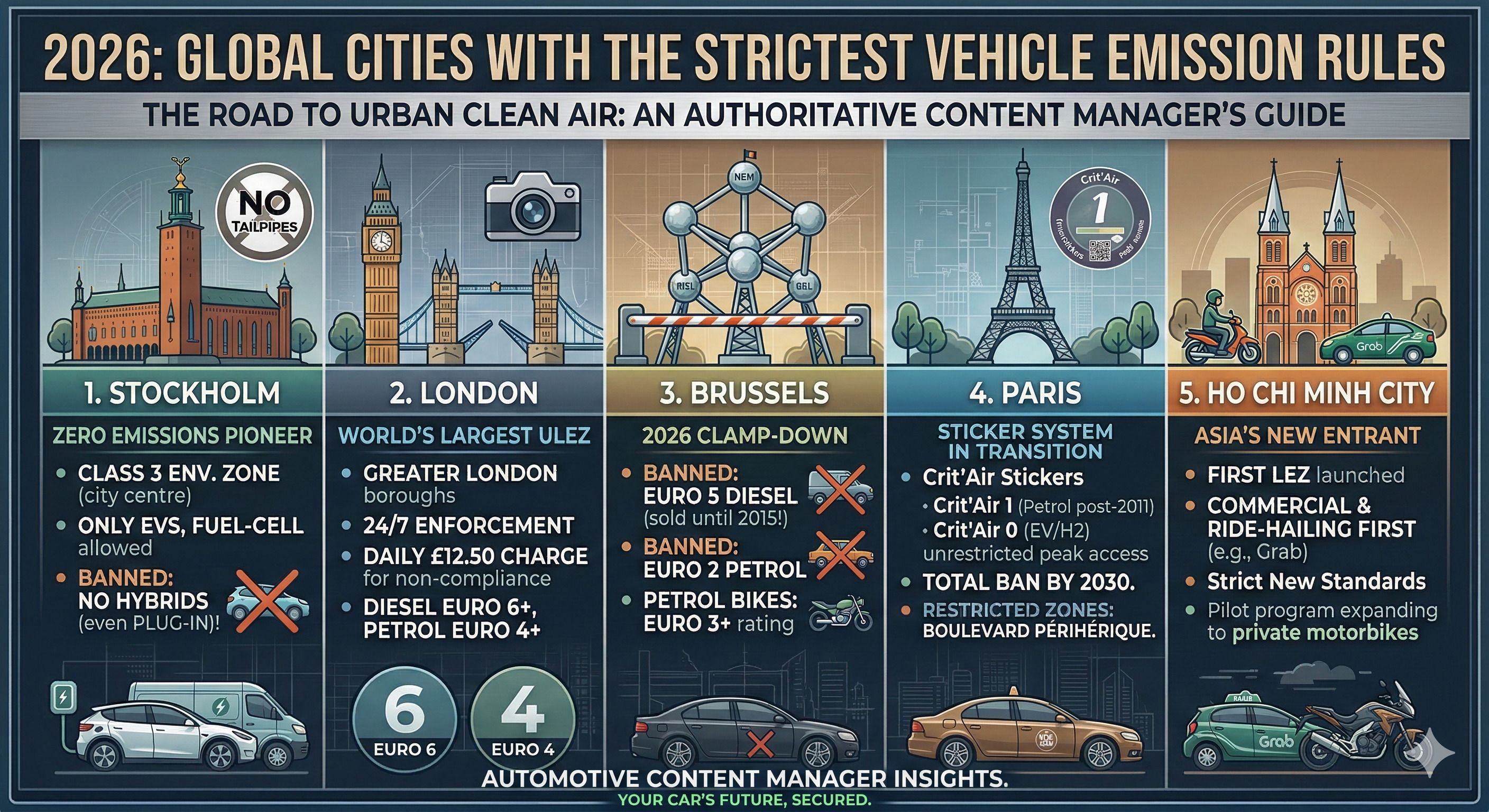
In 2026, Stockholm officially took the crown for the most aggressive stance on urban driving. While other cities allow "clean" petrol or diesel cars for a fee, Stockholm’s Class 3 Environmental Zone in the city centre is essentially a closed shop.
Only fully electric vehicles, fuel-cell cars, and Euro 6 gas-powered heavy vehicles are allowed entry. The real kicker here is the ban on plug-in hybrids. In most of Europe, a hybrid is seen as a green choice, but in the heart of the Swedish capital, it is treated like any other combustion engine. If it has a tailpipe, it is likely staying outside the zone.
2. London: The World’s Largest ULEZ
London may not be as strict as Stockholm in terms of technology bans, but it wins on sheer scale. Following the 2023 expansion to all London boroughs, the Ultra Low Emission Zone (ULEZ) remains a 24/7 enforcement machine.
To enter without paying the £12.50 daily charge, diesel cars must meet Euro 6 standards (generally those registered after 2015) and petrol cars must meet Euro 4 (generally post-2006). What makes London particularly strict is the enforcement density. With thousands of cameras and no "off-peak" hours, it is nearly impossible to navigate the capital in a non-compliant vehicle without the system catching you.
3. Brussels: The 2026 Clampdown
Brussels has introduced a major update to its Low Emission Zone (LEZ) that has caught many by surprise this year. As of January 2026, Euro 5 diesel vehicles and Euro 2 petrol vehicles are officially banned from the entire Brussels-Capital Region.
This is a significant move because Euro 5 diesels were sold as recently as 2015, meaning relatively modern family cars are now facing fines of up to €350. The city is also unique in how it handles motorcycles, with petrol bikes now requiring at least a Euro 3 rating to enter. It is one of the most comprehensive "step-by-step" phase-outs in the European Union.
4. Paris: The Sticker System in Transition
Paris remains a headache for tourists and residents alike thanks to the "Crit'Air" sticker system. By 2026, the city had planned to ban all diesel vehicles, though they have recently introduced "grace periods" for certain stickers to help residents transition.
Currently, only vehicles with Crit'Air 1 (petrol post-2011) or Crit'Air 0 (Electric/Hydrogen) have unrestricted access during peak hours. If you are driving an older diesel, you are restricted from the Boulevard Périphérique and everything inside it between 8 am and 8 pm on weekdays. The long-term goal for Paris is a total ban on all internal combustion engines by 2030, making it one of the most ambitious cities in the world.
5. Ho Chi Minh City: Asia’s New Entrant
While Europe usually dominates the conversation, 2026 marks a turning point for Southeast Asia. Ho Chi Minh City has officially launched its first low emission zones this year.
The strategy is focused first on commercial and ride-hailing vehicles. If you are driving for a platform like Grab or operating a delivery van, you must meet strict new standards or face exclusion from the city centre. It is a pilot program that is expected to expand to private motorbikes by 2027, signalling that the "clean air" movement is no longer just a Western phenomenon.
How to Stay Compliant
The most important thing for any driver in 2026 is to realise that a car that is "legal" in one city might be "illegal" in the next. Madrid, for example, has different rules for residents versus visitors, and some German cities like Berlin require a physical green sticker that must be ordered weeks in advance.
Before you drive into any major city centre, always check the local council or government website for the specific "ZBE" (Zona de Bajas Emisiones) or "LEZ" rules. The fines are automated, and in 2026, they are higher than they have ever been.