
Most British motorists do not neglect their vehicles out of spite or malice. Life simply gets busy, the daily calendar fills up, and because the car starts without hesitation every single morning, it is easy to assume everything under the bonnet is completely fine. We fall into a false sense of security right up until the exact moment a breakdown occurs. Suddenly, you find yourself stranded with a dead battery on a rainy Tuesday evening, discovering a bald tyre you completely missed, or staring at a red dashboard symbol five minutes before a critical appointment.
Maintaining a vehicle does not require you to spend your precious weekends covered in grease or handing over large sums of cash to a local garage. By implementing a straightforward, structured car maintenance checklist, you can intercept the vast majority of predictable mechanical failures and stressful MOT rejections before they ever disrupt your day.
Taking ownership of your vehicle's health is entirely a matter of breaking down inspections by frequency, aligning your routine with official safety benchmarks, and catching small issues before they spiral into expensive repair bills.
The Two-Minute Weekly Walkaround
Integrating a few swift visual checks into your weekly routine—perhaps right before you set off for the weekly food shop—is the absolute best defence against sudden safety hazards. You do not need to lift the bonnet for this initial phase.
1. The Tyre Visual Sweep
Take a slow walk around all four corners of the vehicle. You are not conducting a microscopic engineering inspection here; you are simply scanning for glaring anomalies. Look for an obvious drop in profile that indicates a slow puncture, prominent bulges or gashes in the structural rubber sidewall, or sharp metallic objects like nails embedded deeply into the tread. Under UK law, the absolute legal minimum tread depth is 1.6mm across the central three-quarters of the tyre around its entire circumference, but catching a progressive deflation early prevents structural tyre failure at motorway speeds.
2. The Lighting Check
Blown bulbs are the single most common cause of first-time MOT failures in the UK. Test your indicators left and right, click on your hazard lights, and flash your main beams. To check your rear brake lamps without a helper, look for their reflection in a shop window or a garage wall behind you when you press the pedal, or use your smartphone camera to record a quick ten-second clip from the pavement.
3. Windscreen and Visibility Clearance
Examine your glass for fresh stone chips or hairline cracks, particularly within the driver's critical field of vision. A minor chip can be filled cheaply by your insurance provider, but if left unattended, seasonal temperature changes will cause it to fracture across the entire screen, necessitating an expensive full replacement.
The Monthly Mechanical Health Check
Once a month, it is time to dedicate ten minutes to inspecting the vital components that keep your car running efficiently.
1. Calibrated Tyre Pressures
Tyre pressures must always be measured when the rubber is completely cold, as driving even a few miles warms the internal air and artificially inflates the reading. Grab the correct bar or PSI parameters from the placard inside your driver's door frame or fuel cap cover, and use a digital gauge to check all four wheels. Under-inflated tyres drastically increase rolling resistance, which kills your fuel economy, accelerates tread wear on the shoulders, and significantly extends your stopping distances in the wet. If your vehicle carries a traditional spare wheel in the boot recess, check it now; a flat spare wheel is completely useless in an emergency.
2. Under-Bonnet Fluid Verification
Pop the bonnet latch and locate the primary fluid reservoirs, which manufacturers usually colour-code clearly.
- Engine Oil: Pull the physical dipstick, wipe it clean with a rag, reinsert it fully, and draw it out again. The oil residue should sit comfortably between the minimum and maximum notch indicators.
- Engine Coolant: Visually check the level through the translucent side of the expansion tank. Never open this cap while the engine is warm, as the cooling system is highly pressurised and will release boiling steam.
- Screenwash: Fill this reservoir right up to the brim using a dedicated screenwash concentrate rather than plain water, which fails to cut through oily road grime and bugs.
The Mid-Year Wear and Tear Audit (Every 3 to 6 Months)
As the months roll by, certain consumable components require physical and sensory monitoring to track their degradation.
1. Sensory Brake Check
Listen for high-pitched squealing or harsh grinding noises under load. Feel for any new vibrations through the pedal or a subtle tendency for the steering wheel to pull toward the left or right when slowing down.
2. Wiper Blade Degradation
UK weather is notoriously unpredictable, meaning your wiper blades face heavy usage. If the rubber has started to split from the frame, or if they leave wide, watery smears across your field of vision, swap them out immediately. It is a cheap, five-minute upgrade that completely transforms your driving visibility in a downpour.
Seasonal Shifts and the TRIP Mindset
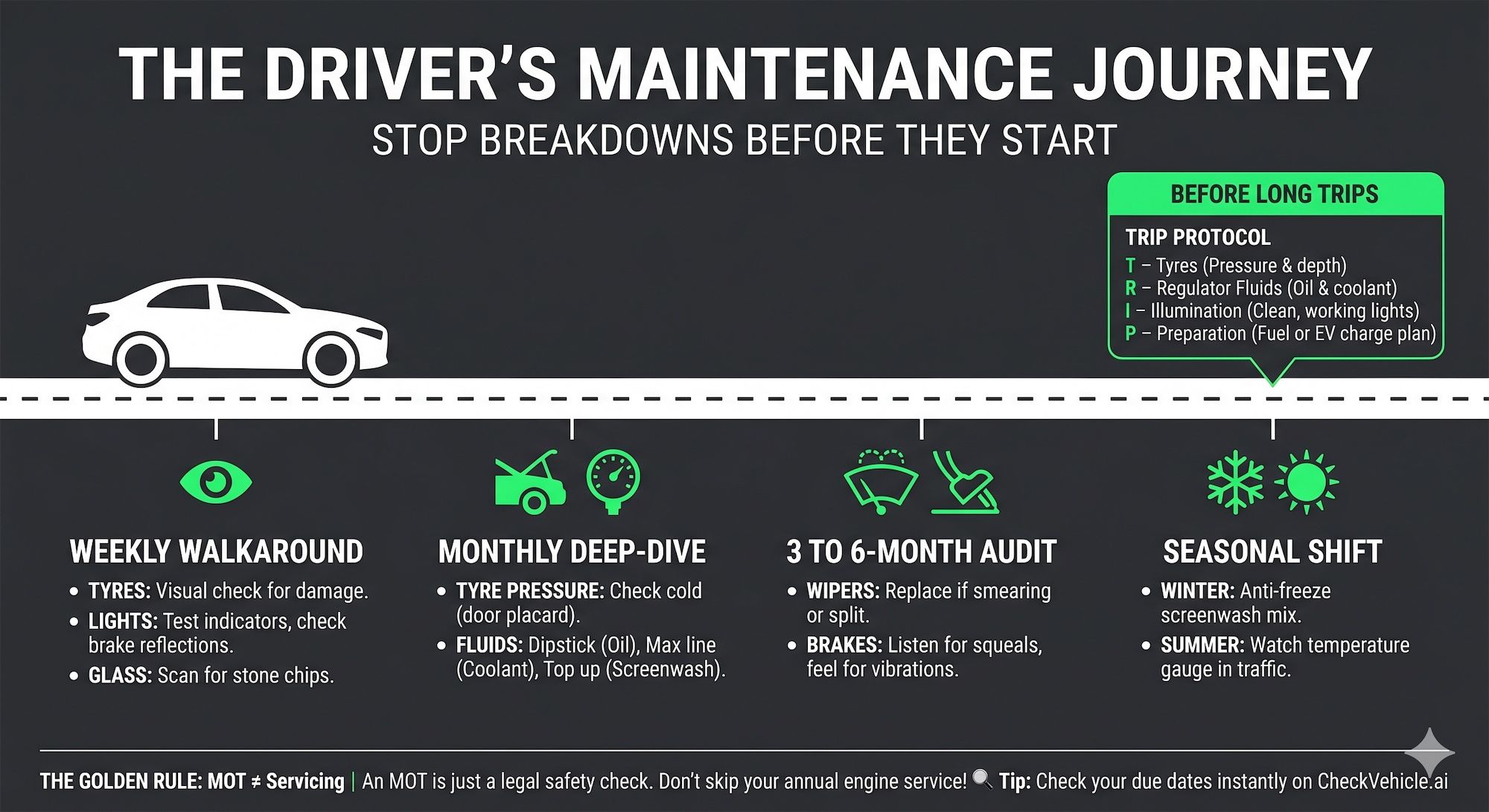
National Highways statistics prove that a staggering number of roadside breakdowns are entirely avoidable, frequently caused by fundamental oversight regarding fuel, tyres, and engine fluids. Before embarking on any long cross-country journey, or when transitioning between seasons, run through the TRIP protocol:
- T - Tyres: Verify both the pressures and real tread depth before loading up luggage.
- R - Regulator Fluids: Confirm your engine oil and coolant levels are optimal to prevent overheating on long motorway stretches.
- I - Illumination: Ensure every single exterior lamp is clean and fully operational.
- P - Preparation: Verify your fuel level or planned electric vehicle charging stops to eliminate route anxiety.
During late autumn, transition over to a dedicated winter‑grade screenwash mix to prevent the fluid from freezing inside the delivery lines when temperatures drop below zero. Conversely, as summer approaches, pay close attention to your temperature gauge while sitting in stationary traffic to ensure your cooling fans are cutting in properly.
A simple “maintenance rhythm” you can stick on your phone
If you’d like a no-drama routine, this works for most drivers:
- Weekly: quick tyres, lights, windscreen
- Monthly: tyre pressures, fluids, battery signs
- Every 3 to 6 months: brakes feel, wipers, filters check
- Seasonal: winter/summer prep
- Before long trips: the short safety sweep
- Annually: MOT + service planning
It’s not fancy. It just works.
Navigating Annual Requirements: MOT vs. Servicing
A significant percentage of British drivers mistakenly treat the annual MOT inspection as a comprehensive vehicle service. This is a potentially dangerous misconception. An MOT is a statutory minimum safety and emissions check required by law once a vehicle reaches its third anniversary. It simply confirms the car is legally roadworthy at the exact moment of the test; it does not evaluate the internal health of your engine, the quality of your oil, or the wear on your spark plugs.
To keep your car running reliably over the long term, you must adhere to your manufacturer’s separate servicing schedule. If you are tracking multiple family vehicles or cannot remember when your official safety inspection is due, running your registration through an all-in-one platform like CheckVehicle.ai allows you to instantly pull up your exact MOT expiration date, tax brackets, and historical testing milestones in a single look. Staying proactive with your car maintenance checklist is the absolute best way to keep your running costs low, protect your vehicle's resale value, and drive with total confidence every single day.