Cars rarely suffer a sudden, catastrophic breakdown out of nowhere. Instead, they are slowly worn down by a hundred minor, everyday habits: short trips where the engine never warms up, potholed roads taken a fraction too fast, ignored fluid levels, and that slight dashboard glitch you promised yourself you would look into next month.
The encouraging truth is that extending the physical lifespan of your vehicle does not require you to be a trained mechanic. It is simply about establishing a handful of protective driving and maintenance routines. Done consistently, these simple habits make the absolute difference between a car that feels tired, loose, and unreliable at 90,000 miles, and one that still drives tightly past 160,000 miles.
If you want an official baseline for vehicle upkeep, the GOV.UK guide on keeping your vehicle safe to drive outlines your baseline legal responsibilities, but to truly maximise your car's longevity, try building these ten definitive habits into your regular routine.
1. Treat the First Ten Minutes as Critical Warm-Up Time
One of the most effective mechanical preservation habits costs absolutely nothing. When your car sits parked overnight, the engine oil drains completely down into the oil sump, cooling and thickening in the process.
When you turn the key on a cold morning, it takes several crucial seconds for the oil pump to pressurise and distribute lubrication back to the top of the cylinder head, the valvetrain, and the high-speed bearings of a turbocharger. Forcing a cold engine into rapid acceleration or high revs immediately puts these unlubricated components under immense friction and thermal stress.
- The Best Habit: You do not need to sit stationary idling on your driveway—modern engines actually warm up more efficiently under gentle load. Simply drive off straight away, but keep your gear changes smooth, accelerate progressively, and avoid heavy acceleration or high engine speeds until the temperature gauge settles into its optimal midpoint.
2. Audit Your Fluids Frequently Enough That Problems Can't Hide
Engine components rely entirely on sacrificial fluids to reduce heat, absorb friction, and clean internal channels. When fluid levels drop or become heavily contaminated, the life of major mechanical components is shortened drastically.
- The Best Habit: Set a recurring monthly calendar reminder to lift the bonnet when the engine is completely cold. Pull the engine oil dipstick, wipe it clean, and verify the oil residue sits between the minimum and maximum notch indicators. Visually check the translucent engine coolant expansion tank and the brake fluid reservoir.
- The Golden Rule: Fluids do not simply evaporate from a healthy, sealed engine system. If you find yourself repeatedly topping up your oil or coolant month after month, do not just keep feeding it. A persistent drop points directly to an underlying leak or internal consumption, which needs diagnosing before it turns into a terminal engine failure.
Editor's Note: If you want to build a bulletproof routine for handling these fluid checks and keeping your vehicle roadworthy year-round, be sure to read our comprehensive guide on the ultimate car maintenance checklist.
3. Keep Tyre Pressures Calibrated Monthly
Your tyres affect far more than just your grip on a rainy day; their inflation levels send a ripple effect through your entire steering and suspension geometry.
- The Best Habit: Check your tyre pressures once a month using a calibrated digital gauge. This must always be done when the rubber is completely cold, as driving even a few miles warms the internal air and artificially inflates the reading.
- Why It Extends Car Life: An under-inflated tyre creates a wider, saggy footprint on the tarmac. This drastically increases rolling resistance, which kills your fuel economy and generates excessive internal heat. This extra drag forces your engine, power steering rack, and front suspension tracking components to work significantly harder than factory parameters intend, accelerating wear.
4. Drive Through Potholes and Speed Bumps Professionally
The UK’s local road networks are heavily plagued by deep potholes, sunken utility covers, and aggressive speed cushions. Crashing through these rough surfaces at speed is the automotive equivalent of punching your car in the knees twice a day.
- The Best Habit: Never slam your brakes on while you are actively rolling over a pothole or speed bump. Braking compresses the front suspension springs, locking them solid and forcing the absolute maximum kinetic shockwave directly into your alloy wheels, wheel bearings, suspension ball joints, and track rod ends.
- The Correct Method: Look further ahead, ease off the power, and do your braking before the hazard. Release the brake pedal just as you reach the uneven surface to allow the suspension springs full travel to absorb the impact naturally.
5. Practice Progressive, Long-Range Braking
Aggressive, late braking is entirely self-inflicted mechanical wear. Rushing into roundabouts, tailgating the vehicle in front, and slamming the pedal down hard creates a highly volatile environment for your braking hardware.
- The Best Habit: Shift your eyes further down the road to anticipate traffic flow. By easing off the accelerator early and braking progressively rather than suddenly, you reduce heavy thermal cycles on the brake discs. This prevents the metal from warping, minimises brake pad friction wear, completely eliminates brake dust build-up, and protects your wheel bearings from excessive heat.
6. Never Ignore Intermittent Warning Lights
An amber warning symbol that illuminates for a single journey and vanishes the next morning is a dangerous psychological trap. It is incredibly easy to dismiss it as a temporary computer glitch and put off getting it checked.
- The Best Habit: Treat an intermittent light as a live warning. Many terminal mechanical faults start their lives as minor electrical fluctuations, a sensor begins to short-circuit, an alternator regulator starts to waver, or a cylinder experiences a minor misfire only under specific loads. The car's internal computer logs these errors as permanent historical codes even after the dashboard light switches off. Scan the vehicle with a diagnostic tool promptly to intercept the fault before it leaves you stranded or damages expensive catalytic converters.
Editor's Note: Unsure whether that illuminated symbol requires an immediate roadside stop or a simple garage booking? Check out our detailed breakdown on dashboard warning lights and what they mean to decode your instrument cluster instantly.
7. Maintain a Strict, Schedule-Driven Service Rhythm
An annual MOT test is a mandatory legal requirement, but it is not a vehicle service. An MOT simply checks that the car meets minimum safety limits at that exact moment; it does not replace old filters, evaluate internal engine wear, or refresh crucial additives.
- The Best Habit: Strictly adhere to the service intervals outlined in your vehicle's handbook, regardless of whether you cover low miles. Fresh engine oil loses its protective chemical properties over time, becoming acidic and abrasive. Ensure your servicing routine regularly includes changing the engine air filter, cabin filter, and flushing the brake fluid and coolant on time to keep internal systems clean and free of corrosion.
8. Take Diesel Vehicles on Regular Motorway Runs
If you drive a modern diesel car, its exhaust system relies heavily on a Diesel Particulate Filter (DPF) to capture harmful soot emissions. To keep this filter from choking, the car must regularly trigger an automated self-cleaning cycle known as DPF regeneration.
- The Best Habit: If your diesel vehicle spends its entire life running short, five-minute urban errands to the local schools or supermarkets, the exhaust will never reach the sustained high temperatures required to trigger regeneration. The DPF will inevitably block, resulting in sudden power loss and thousands of pounds in repair bills. If your driving is predominantly urban, make a conscious habit of taking the car on a continuous, thirty-minute motorway run every couple of weeks to allow the exhaust system to clear itself out properly.
9. Clean the Hidden Areas That Fast-Track Rust
A sparkling clean bonnet looks excellent, but cosmetic cleanliness does very little for the actual longevity of the metal structure beneath the paint. The real damage to your car's lifespan happens out of sight.
- The Best Habit: When washing your car, particularly during the winter months when gritters lay down heavy layers of road salt, direct your pressure washer or hose deep inside the inner wheel arches, along the door sills, underneath the chassis edges, and around the boot drainage channels. Road salt combined with trapped road mud acts like a wet sponge, rapidly accelerating structural rust that will eventually cause your car to fail its MOT on body corrosion.
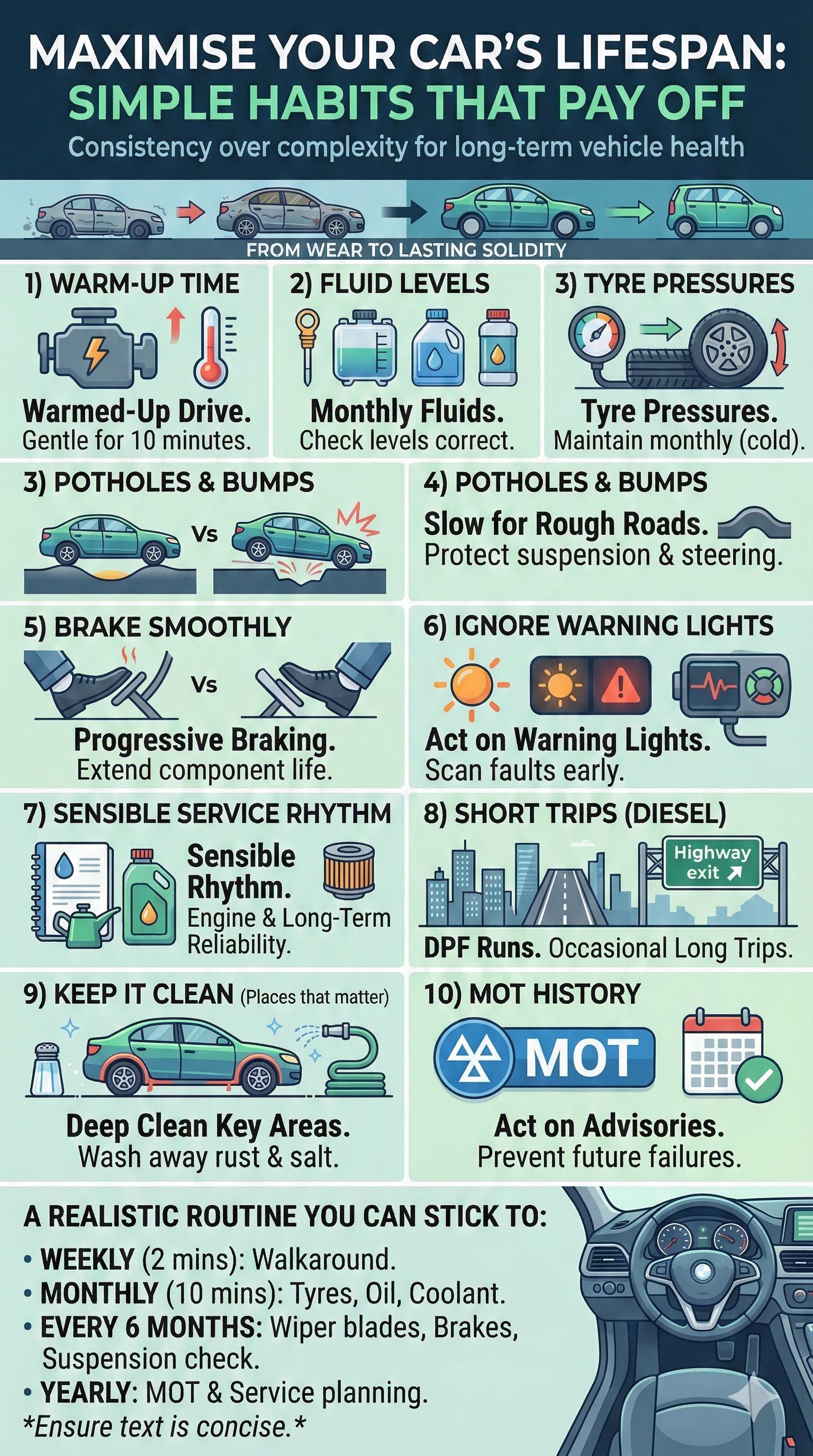
10. Use Historical MOT Advisories as a Predictive Repair List
When your car passes its annual MOT, the absolute worst thing you can do is throw the paperwork into the glove box and forget about it until next year.
- The Best Habit: Carefully evaluate the advisory section. Advisories are formal notes from the inspector detailing components that technically clear the minimum legal threshold on the day of the test but are actively wearing out. You can easily monitor your vehicle's long-term historical trends by entering your registration plate into the official GOV.UK MOT history service.
- Actionable Advice: If you prefer to review your testing timeline alongside comprehensive vehicle tax and ownership data in a single, streamlined dashboard, utilising an all-in-one vehicle intelligence check like CheckVehicle.ai acts like an automated checklist. Pick one or two noted advisory components—like a slightly worn suspension bush or thinning brake pads—and fix them early. Handling wear items before they fail stops them from unbalancing and breaking the surrounding machinery, keeping your vehicle feeling tight, solid, and safe for years to come.